For half a century, single-sideband (SSB) technology has replaced amplitude modulation (AM) as the most popular method of voice transmission in the shortwave band, primarily due to its spectral efficiency, as it requires only about half the bandwidth of an AM signal. Now there is a new digital voice transmission method from FreeDV called Radio Autoencoder (RADE), which also uses only half the bandwidth of an SSB signal and reportedly provides more natural-sounding voice quality. According to Amateur Radio Digital Communications (ARDC), which funded the research leading to the development of RADE, FreeDV’s RADE combines machine learning with classical digital signal processing (DSP) and can operate at signal-to-noise ratios (SNR) as low as -2 dB. The design also takes into account spectrum utilization, voice quality, and energy efficiency—all of which are important aspects of voice communication in the shortwave band.
According to the ARDC, it is particularly important that manufacturers begin integrating the voice transmission method directly into their radios, initially using a module that can be downloaded and installed on certain FlexRadio models. Users of other transceivers can access this mode via computers connected to their radios. For more information, visit FreeDV.
Featured image:
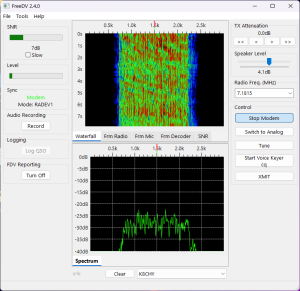
The FreeDV RADE digital voice
signal occupies only 1.5 kHz, half the
bandwidth of an SSB signal.
[Image from FreeDV.org]