The Mini-Whip Antenna
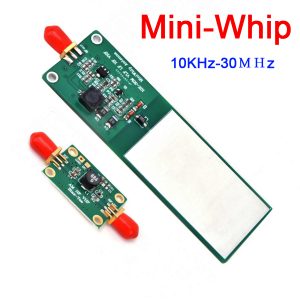
(developed by PA0RDT) is a Extremely compact, active receiving antenna for the long-, medium-, and short-wave bands, as well as lower FM frequencies.
How It Works and Its Structure
- E-field probe: The antenna primarily detects the electric field component (E-field) of a radio wave. The receiving element is often barely larger than a postage stamp (a small metal surface on a printed circuit board or a short rod).
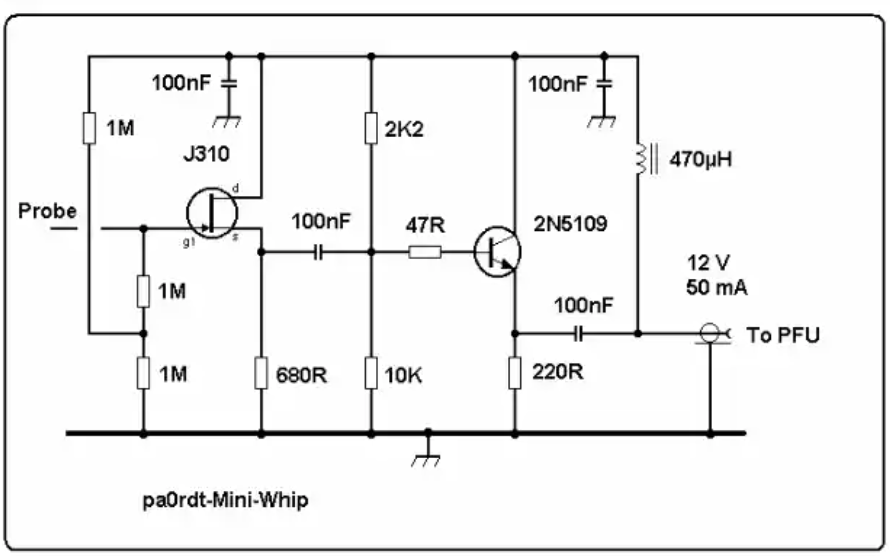
- Impedance converter: A downstream field-effect transistor (FET) provides extremely high input impedance and low output impedance. This allows the signal to be transmitted with minimal loss to a 50-ohm or 75-ohm coaxial cable.
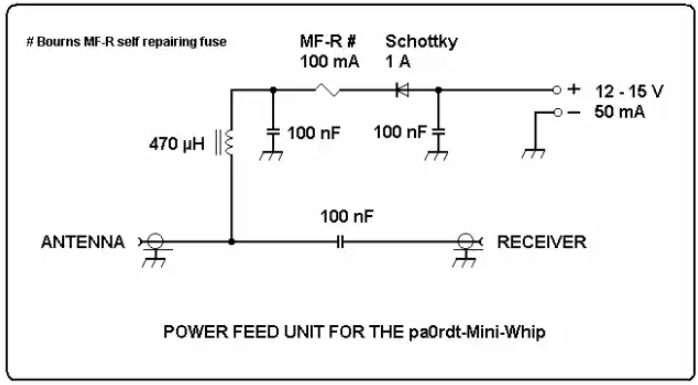
- Remote Power Supply: Power (usually 9V to 12V) is supplied directly through the coaxial cable via a remote power splitter (Bias-T), eliminating the need for a separate power cable at the antenna.
Features and Applications
- Advantages: Despite its small size, it delivers amazing reception performance at low frequencies and can be mounted discreetly (e.g., on a mast or a fishing rod).
- Disadvantages / Notes: Because it reacts to electric fields, it is susceptible to local near-field interference (e.g., from power supplies or electronics in the home). It should therefore be placed as high up and as far away from sources of interference as possible. It is often advisable to install a shield wave blocker on the coaxial cable to reduce common-mode interference.
Circuit, Antenna
BIAS-T Circuit
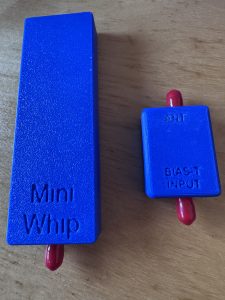
3D-Printed Housing